THE PROJECT
It’s Your History, Bro!
Make Memories
from Memories
Empowering Young Ambassadors of Holocaust Remembrance and European Values
Is a two-year international initiative uniting university, research institutions, and schools across Italy and the EU. Our goal?
To foster a deep sense of belonging to European history and values—especially among youth, with or without a migratory background.
Events and news from the project
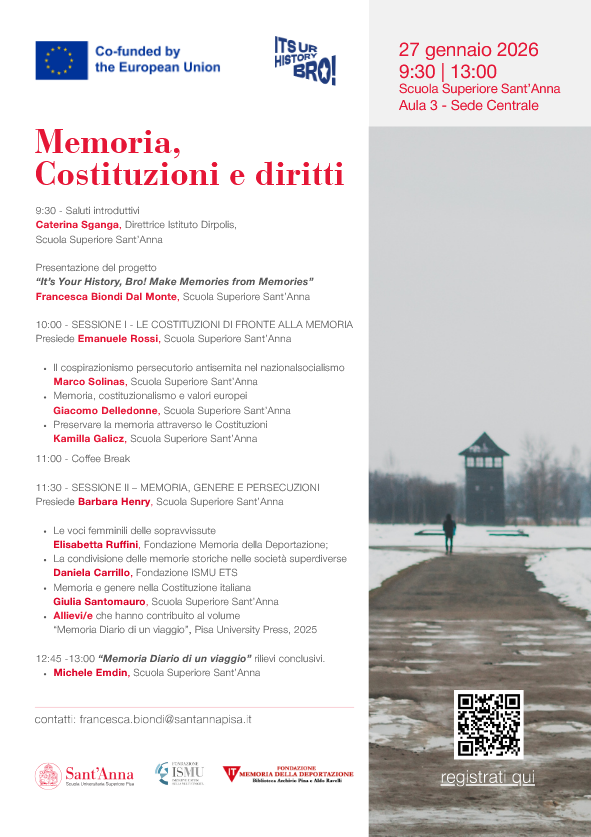
Memories, consitutions and rights
On 27 January, International Day of Commemoration in Memory of the Victims of the Holocaust, the partners of the European project “It’s Your History, BRO! – Make memories from memories”, Fondazione Memoria della Deportazione, Fondazione ISMU, and Scuola Superiore Sant’Anna, gathered in Pisa on the occasion of the conference “Memoria, Costituzioni e diritti” to publicly kick-start the project path that is bringing students, universities, and citizens into dialogue on the concept of memory. (…)
the context
Why it matters?
Antisemitism, racism, and intolerance thrive where memory is ignored. “It’s Your History, Bro!” addresses this by
- reviving female voices of the Holocaust
- training students to listen and share unsettling narratives
- supporting educators in diverse classrooms
- using memory to resist hate and foster unity
Together, we are building a future where memory empowers action, inclusion, and solidarity across Europe.
It started on March 2025 and will run until February 2027
What is “It’s Your History, Bro!” about?
This project trains students to become New Young Ambassadors (NYAs) of Holocaust remembrance, equipping them with the tools to engage their peers and wider communities—particularly migrant communities—in critical reflection on the past and present. By integrating historical memory with innovative teaching methods, “It’s Your History, Bro!” promotes inclusive remembrance and combats antisemitism and discrimination.
the objectives
Promote European rights and values
Empower diverse youth to become ambassadors of Holocaust memory—valuing their languages, experiences, and backgrounds.
Reflect the plurality of European societ
Encourage conversations about challenging histories, amplifying voices often left unheard.
Make new memories from memories
Support young people in producing and sharing new narratives through Journeys of Memory, podcasts, and intercultural exchanges.
Innovate remembrance practices
Develop and spread new methods of Holocaust remembrance—gender-sensitive, inclusive, and rooted in law, ethics, and intercultural storytelling.
the actions
Main activities
Development of training tools
Interdisciplinary resources linking Holocaust memory to law, gender, and migration
Youth-Led content creatio
Podcasts and stories translated into multiple languages to foster broader impact.
Public Debates & research
Dialogues and research outputs on laws, memory, and inclusive education.
Engagement of marginalized groups
Activities designed for audiences often excluded from mainstream historical discourse.
the partners
Consortium members
Memory of Deportation Foundation (MDF) — Italy
COORDINATOR
A leading archive and research centre focused on deportation memory and public history. MDF combines historical preservation with educational innovation, offering teacher training and school programs.
Sant’Anna School of Advanced Studies (SSSA) — Italy
A top-tier public university through its DIRPOLIS Institute, focusing on law, politics, and development. With the DREAM research group, it leads in migration, inclusion, and anti-discrimination research and EU project coordination.
Daniela Carrillo, Luca Merotta, Cecilia Lindenberg, Giulia Landi, Francesca Locatelli, Anna Facchetti.

Funded by the European Union. Views and opinions expressed are however those of the author(s) only and do not necessarily reflect those of the European Union. Neither the European Union nor the granting authority can be held responsible for them.