Press release
In 2024, Asylum Applications Increased in Italy but Recognitions Decreased:
Only 7.6% Granted Refugee Status
On the occasion of World Refugee Day, to be celebrated on June 20, ISMU Foundation highlights that, according to Eurostat data, in 2024 the number of international protection applications submitted across EU Member States reached 997,000, marking a 12% decrease compared to the 1.13 million in 2023.
With almost 159,000 asylum applications, Italy ranks third after Germany and Spain. Applications filed in Italy account for 16% of the EU total. Since 2021, asylum applications in Italy have steadily risen, reaching their highest level in a decade in 2024.
Globally, according to the 2024 Global Trends Report by the United Nations Refugee Agency (UNHCR), by the end of April 2025 there were 122.1 million people forcibly displaced from their homes — an increase from 120 million during the same period in the previous year. The primary drivers of displacement remain major conflicts, including those in Sudan, Myanmar, and Ukraine.
In Italy, only 7.6% are granted refugee status. Regarding first-instance decisions, the ISMU Foundation reports that in 2024, nearly two-thirds of international protection requests in Italy — over 50,000 out of 78,000 examined — were rejected. This rejection rate exceeds the EU average, where negative outcomes account for less than half (48.6%) of decisions. Consequently, in 2024, just over one-third of asylum applications in Italy were approved, and only 6,000 people were granted refugee status — 7.6% of the total.
Italy in the European context. With regard to first-instance asylum decisions, data from 2012 to 2024 show that Italy consistently grants refugee status at lower rates than the EU average: 10% vs. 23%.
The highest recognition rate in Italy was recorded in 2021, when 17% of examined cases resulted in refugee status. In contrast, the highest recognition rate across the EU was in 2015, when 39% of cases were granted protection under the Geneva Convention.
A notable feature of the Italian asylum system is the use of humanitarian protection, which is not available in many EU Member States: in 2024, humanitarian permits accounted for 41% of all positive decisions in Italy (over 11,000 cases), compared to an EU average of 17%. The share of subsidiary protection was similar between Italy and the EU as a whole: 38% vs. 40%.
Why are so many asylum applications rejected in Italy? The higher rejection rates in Italy, compared to the EU average, are primarily due to the large number of applications from nationals of countries with low recognition rates, such as Morocco, Egypt, Tunisia, and Bangladesh — nationalities for which 80% to 90% of applications are denied.
Conversely, in the EU overall, higher recognition rates are linked to applicants from countries with high positive decision rates, such as Syria (92%), Venezuela (89%), and Afghanistan (81%) — countries whose nationals are more often granted refugee status.
Who are the refugees granted protection in Italy? In 2024, refugee status in Italy was granted to 46% of Afghan nationals, 20% of Cameroonians, 18% of Ivorians, and 16% of Nigerians. For the latter African nationalities, women represent the majority – making up more than two-thirds of those granted refugee status.
In the EU as a whole, Eritrea shows the highest refugee status recognition rate (over two-thirds), followed by Afghanistan (54%) and Somalia (36%).
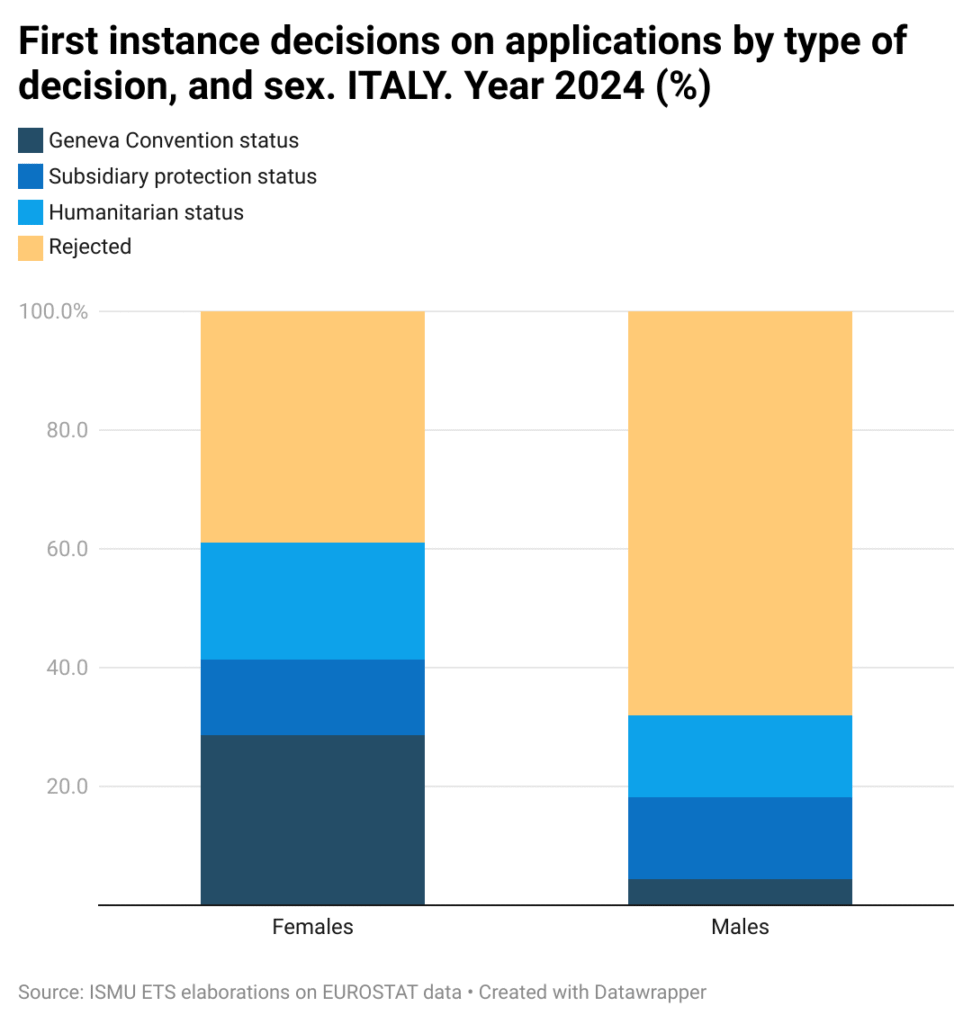
29% of refugees in Italy are women. In 2024, 68,000 protection applications were submitted by men and 10,000 by women in Italy. Among the women, over 6,000 (60%) received a positive outcome, while negative outcomes predominated for men.
Refugee status is significantly more often granted to women: 29% of female applicants received refugee status, compared to just 4.5% of male applicants.
Graphs


Follow us
FACEBOOK @fondazioneismu – X @Fondazione_Ismu – LinkedIn Fondazione ISMU (Iniziative e Studi sulla Multietnicità) – Instagram ismu_eu
Information
Ufficio stampa ISMU ETS, Tamara Ferrari, cell: +39 335.5395695
ufficio.stampa@ismu.org